Guest Post By Brittany Smith and Joseph Wayne Smith, Department of Psychology, University of Adelaide, South Australia
I
The collapse of techno-industrial civilization is likely to occur on the present business-as-usual mode of social functioning, probably by 2030, but there are scenarios where it could be before Christmas 2022, if the West and Russia slide into nuclear war; that is our position, supported here. This article is a response to Adam Van Buskirk’s paper “Collapse Won’t Reset Society” (Van Buskirk, 2022), who argues that collapse does not lead to the Mad Max/zombie apocalypse scenario, even in the case of all-out nuclear war. We could not disagree more; hence this response. But the Van Buskirk article is typical of “normie” responses to the confrontation with civilizational collapse, so it is instructive to critique his article as a sample of a general pattern of thought. Indeed, the senior member of this duo was reminded of the famous record album cover by the English rock group Super Tramp, Crisis, What Crisis? (1975), featuring a guy laying back relaxing in a deck chair, under an umbrella, with chaos and destruction all around him. He is oblivion to the dark fate that is rushing to engulf him. Most people, including academics and general members of the chattering class, are like that guy in the deck chair.
According to Van Buskirk “collapse” (a term which will need to be explicated below) and “the threat of imminent destruction” is a “thrilling possibility” to some people from both progressive and conservative groups, including “backwoods fundamentalists, deep green radicals, apocalyptic cults, and pessimistic online doomers.” That is indeed true, with “collapse” being a hot topic on YouTube, discussed daily at sites such as Canadian Prepper, The Angry Prepper, The Prepared Homestead, Ice Age Farmer and The Modern Survivalist (“Ferfal”), to name but a few. This selection, by the way, is highly racially diverse, so doomsday is not an exclusive preoccupation of “Whiteness.”
Van Buskirk is also correct, in our opinion, to see many, who often express their frustration at chat sites, as looking forward to the destruction of a social order where they are at the bottom of the wheelie bin and devalued. The intellectualization of this must be anarcho-primitivism which sees techno-industrial society as destructive to human community and the environment and maintains that collapse is needed to save both humanity and nature (Jensen, 2018; Zerzan, 2002).
Van Buskirk argues that humanity has seen both natural and human-caused disastrous numerous times in the past. He does not mention this example, but perhaps the most dramatic case of humanity dodging a giant bullet occurred 70,000 years ago when a climate change-induced mega-drought almost led to human extinction, with world population numbers crashing to as little as 2,000 (Behar et al., 2008).
Here’s The Harsh Reality: Today, The Biggest Risk For Global Catastrophe Isn’t What It Was 50 Years Ago…
This presentation PROOVES WITHOUT DOUBT that America is in for a major fight that will put you and your family in the firing line, literally… So make sure you watch this presentation while it’s still online…
Van Buskirk points out that the “Black Death,” (a form of bubonic plague pandemic) in Europe and Asia during the 14th century killed, according to some estimates, over 50 million people, between 30 and 50 percent of the population of the regions. Yet despite this, there was business-as-usual as far as possible. The English law courts and universities experienced only minimal disruption. The state did not collapse, there was no widespread anarchy as depicted in contemporary zombie apocalypse fiction, such as The Walking Dead. Society did not collapse. Van Buskirk is correct; but this is not a case of societal, let alone civilization collapse at all as he shows that there was no such collapse. Certainly, it was a situation of social crisis, as COVID-19 has been, but humans adapted and survived, something Annalee Newitz illustrates in Scatter, Adapt, and Remember (2014), as humans have done remarkably well as “whether the disaster is caused by humans or by nature, it is inevitable” (Newitz, 2014, p. 1).
Still, the Black Death impacted upon a pre-modern Europe which was much more decentralized than contemporary Europe, and it was not based upon a mass technological society, where basic life support mechanisms (food supply by the “just-in-time” system, energy, water, and sewers) were dependent upon a vast number of technicians keeping everything ticking over. There is opinion that another Black Death with a death rate of 30-50 percent would collapse techno-industrial society and if the infection/death ratio of the Black Death or the Spanish Flu was higher, some believe that the human race would have become extinct (Smith, 1998). However, let us not quibble about such numbers; in the discussion below we consider a plausible threat which could reduce a population by 90 percent, and that is surely enough to “collapse” any society in a sense to be defined.
Van Buskirk gives a fascinating account of the destruction (in part) of Nazi Germany, and its reconstruction. Interestingly enough firebombing did not destroy all the paperwork, and the bureaucracy continued in Allied-occupied Germany which in 1949 became the Federal Republic of Germany. Even foreign veterans got their pensions. Again, this is not a case of “collapse,” at least beyond the short term, as while most of Germany was bombed, it was rebuilt by the Allies and the state was reconstructed by them.
Van Buskirk finally considers the nuclear exchange scenario, and he says that the US government (no references given) predicts a death toll of around 13 to 34 million from a nuclear exchange involving 3,000 warheads. Van Buskirk believes that even with the kick-on effects of infrastructure breakdown and famine, the death toll would probably only be 10-20 percent of the total population. We challenge this cozy optimism in the discussion below.
II
There has been intellectual interest in the rise and fall of civilizations at least from the time of Plato (428-347 B.C.) and other ancient Greek philosophers who speculated about various ages, and lost Atlantis. The issue was discussed in other cultures as well, including the Arabic and Chinese (Servigne & Stevens, 2020) and thus has been of perennial interest to thinkers. Edward Gibbon (1737-1794) in his treatise, The Decline and Fall of the Roman Empire ([1776], 2003), outlined the forces leading to the fall of the Roman empire, if not “collapse.” The Roman Empire covered 1.9 million square miles in 390 AD, but by 395 it fell to 770,000 square miles and by 476 AD, zero (Kemp, 2019). Rome was sacked by the Visigoths in 410 and Vandals in 455 (Heather, 2010). Ancient Rome had engaged in imperial expansion with a vast army needed to maintain its empire, and experienced expanding costs and rising inflation. There was a subdivision of provinces with bureaucracies that were also an economic drain. Rome thus was weakened economically, ideologically and culturally, and was vulnerable in the end to barbarian assault.
The field of collapseology (Servigne & Stevens, 2020) tends to adopt a definition of “civilization” along the lines of “society with agriculture, multiple cities, military dominance in its geographical region and a continuous political structure” (Kemp, 2019). Civilizations have functional cities, concentrated settlements with “political consolidation, economic specialization, social stratification, some sort of monumental architecture, and a flowering of artistic and intellectual endeavors” (Price, 315). “Collapse is the breakdown of civilization,” a rapid and enduring loss of population, identity and socio-economic complexity. Public services crumble and disorder ensues as government loses control of its monopoly on violence” (Kemp, 2019, Middleton, 2017). A “Dark Age” may follow this loss of socio-political complexity with frequent violence in the struggle for survival (Widdowson, 2001). The average lifespan of civilizations, according to Kemp’s study, is 336 years (Kemp, 2019). Some civilizations eventually recover and rebuild, such as China (Newitz, 2014) or evolve into something new, such as Europe (Heather, 2010), but others faced permanent collapse, often with a violent ending, such Easter Island, where resource depletion ultimately led to the people having no wood to build boats to escape the island and they turned upon each other in warfare (Diamond, 1991, p. 296-297). Arguably, contemporary examples of state failure have occurred in the horn of Africa where the rule of law became replaced by the rule of the warlord (Kaplan, 2002).
Thus, contrary to Van Buskirk, states are not immortal and can, and have collapsed. Oswald Spengler in The Decline of West (Spengler, 1926) saw all civilizations including the West subject to the rise and fall, or life and death, a “waxing and waning of organic farms (Spengler, 1926, p. 22). The central thesis, that social entities such as civilizations are “organic forms” was a popular idea at a time when metaphysical reasoning was taken particularly seriously in Germany, but today in our postmodern world this sort of philosophy has fallen on cognitive hard times with a more “scientific” empirical approach to matters being the norm (Smith, 1988).
Arnold Toynbee, in A Study of History (Toynbee, 1949) agreed with Spengler about the rise and fall of all civilizations, seeing this in general coming from the diminishing creative power to solve problems, resulting in a lack of faith and trust of the majority of people in their leaders, and a breakdown of social unity in society as a whole (Toynbee, 1949, p. 246). Sounds familiar! Toynbee compares the breakdown and collapse of societies and civilizations to that of climbers who fall to their death (Toynbee, 1949, p. 245). Unlike with Spengler, the breakdown comes internally, with major challenges that failed to be answered and problems solved.
The problem “receives some tardy and imperfect answer or else brings about the destruction of the society (Toynbee, 1949, p. 364). This is a form of social suicide and self-destruction. A development of this “failure to rise to the challenge of the times, and adequately handle disaster especially regarding the ecological crisis (discussed shortly) has been made by Jared Diamond in Collapse (Diamond, 2005) and Ferguson in Doom (Ferguson, 2022).
A related school of thought in collapseology is that internal factors result in a drift to failure (Dekker, 2011). Joseph Tainter, The Collapse of Complex Societies (Tainter, 1988) sees social collapse as arising from the law of diminishing returns. Increased complexity has increased costs per capita and “[a]t some point in the evolution of a society, continued investment in complexity as a problem-solving strategy yields a declining marginal return” (Tainter, 1988, p. 119-120). Tainter’s work was featured in a cover story edition of New Scientist, April 5, 2008: “The collapse of civilization: It’s more precarious than we realized” (MacKenzie, 2008) and has been developed further (Bardi, 2020; Bardi, Falsini & Perissi, 2018). However, the idea that complex systems are vulnerable to breakdown was argued for earlier by Roberto Vacca in The Coming Dark Age (Vacca, 1973): “our great technological systems of human organization and association are continuously outgrowing ordered control; they are now reaching critical dimensions of instability” (Brunk, 2002; Vacca, 1973, p. 4).
These schools of collapseology are not necessarily inconsistent, since a holistic account would propose that there are both internal and external forces producing collapse so that “synchronous failure” (Homer-Dixon, 2008) would arise from the converging and compounding crises (Steffen & Griggs, 2014) that humanity faces, such as all aspects of the ecological/environmental crisis from soil erosion, water quality and quantity depletion, biodiversity destruction, especially climate change (Collins, 2010; Dilworth, 2009; Kemp, 2019; Kunstler, 2006; Montgomery, 2012; Nyborg, 2012; Ophuls, 2012; Taylor, 2020), leading to a collapse of techno-industrial civilization (Greer, 2016; Orlos, 2013).
Some, such as Umair Haque (journalist) see this process of process of ecologically-based civilization collapse occurring now, but “some of us just don’t know it yet” (Haque, 2022), a view also taken by Near-Term-Human-Extinction proponent Guy McPherson (McPherson, 2013).
In this short VIDEO, I will unearth A lost super-food will bulletproof you against any food shortage or famine. It’s a food that vanished with the Incas over 6 centuries ago
In the next crisis these lost skills will be more valuable than gold, food supplies and survival equipment combined. These skills have been tested and proven to work for centuries.
Here is just a small glimpse of what you’ll find in this massive 300-page sequel (in color) to The Lost Ways:
- A lost super-food will bulletproof you against any food shortage or famine. It’s a food that vanished with the Incas over 6 centuries ago. This mysterious dish was just recently rediscovered by NASA who has been giving away rations of it to our brave men and women in their month-long space missions. The Incas stored it in pit holes for up to 10 years, ate it year-round, and actually used it to survive a 4 year long super-drought that wiped out their southern neighbors. So, if it managed to save the Incas centuries ago and it still works for our astronauts today, you can bet your last dollar it will keep you and your family well fed in any crisis. And the best part is that you probably already have the ingredients in your kitchen right now.
Paul and Anne Ehrlich put the odds of avoiding a starvation-driven collapse of civilization due to a perfect storm of environmental problems arising from over-population and over-consumption at just 10 percent (Ehrlich & Ehrlich, 2013). While the Ehrlich’s have been wrong before in their predictions, this time, unfortunately, on the present business-as-usual scenario of growing fossil fuel use, continuous economic and resource depletion, they may be right. Graham Turner (2012) in a survey of the same environmental variables, concluded that the limits to growth have already occurred and that ecological overshoot to collapse (evidenced by environmental destruction) is already occurring (Turner, 2012). Motesharrei et al., using the HANDY computer model based upon a predator-prey model with humans as “predator” and nature as “prey” concluded that with economic stratification and unconstrained resume use, collapse occurred with decades (Motesharrei, et al., 2014). Herrington (2021) using 2009 data applied to the model of the world economy, used in D. H. Meadows et al., The Limits to Growth (1972) and found that in a business-as-usual scenario of experimental economic growth and intense fossil fuel use, a collapse of global civilization would occur around 2040, long before the Meadows et al. (1972) prediction of a collapse by the mid-to-late 21st century. This conclusion is supported by other research (Abegão, 2011, Bradshaw et al., 2021; Global Resource Observatory, 2014; King & Jones, 2021; Ripple et al., 2021).
Thus, contrary to Van Buskirk, our modern techno-industrial is not immune to collapse. While the environmental threats may result in a long-drawn-out death throe, these are scenarios of a rapid collapse, with survivors facing a world as grim as any portrayed in zombie apocalypse films.
III
According to George Soros speaking at the World Economic Forum in Davos, May 2022, the Ukraine invasion “may have been the beginning of the third world war and our civilization may not survive it” (Elliott, 2022). Soros is not the only leading financier to be concerned about mass death arising from a possible third world war; financial cycle expert Charles Nenner sees a war cycle beginning in 2023, like World War I bigger, with one-third of the world’s population, more than 2.5 billion people perishing (Miami Standard News Staff, 2022).
In contrast to these “pessimists” Van Buskirk (2022) quotes U.S. government estimates of an estimated death toll of 13-34 million people for a nuclear exchange of 3,000 warheads, and a die-off of 10-20 percent of the world population from the effects of this, such as infrastructure destruction, disease, famine and nuclear winter. However, these figures are open to challenge, vast under-estimates, especially the death toll from global famine from nuclear winter (Toon, 2007).
For example, a study by International Physicians for the Prevention of Nuclear War and Physicians for Social Responsibility (Helford, 2013) modelled a limited nuclear war between India and Pakistan and found that this alone would kill up to two billion people by nuclear winter crushing world food production. This conclusion is supported by more recent computer simulations, which indicate that even a limited nuclear war between two powers, such as NATO and Russia, or India and Pakistan, could lead to a “Nuclear Ice Age” lasting thousands of years. Crop failure, the crash of biodiversity, including marine algae, the basis of the marine food chain, will result in global famine and a vast die-off of humans. The exact figure is difficult to calculate since the “Nuclear Ice Age” would collapse techno-industrial society which is ill-prepared for such a mega-disaster (Harrison et al., 2022).
Global nuclear war is likely to involve the use of the explosion of high-attitude nuclear bombs to produce a powerful electromagnetic pulse that would collapse the grid and fry most unprotected electronics (Hay & Pry, 2022). Dr. Peter Pry, Executive Director of the Task Force on National and Homeland Security, is a leading expert on EMP attacks. He has noted that Chinese military doctrine has the notion of “Total Information Warfare,” blackout warfare (Pry, 2021) with EMP attacks taking central stage (Pry, 2020, p. 1) and has Super-EMP weapons that can be readily used in hypersonic missiles (Conca, 2020; Pry, 2020, p. 6). In a recent report, Iran: EMP Threat (Pry, 2022), Dr Pry details how the Islamic Republic of Iran also posed an immediate EMP threat. Official Iran military textbooks detail using EMP attacks against the United States. Iran has hundreds of medium-range missiles that could in principle be armed with a nuclear warhead (perhaps given by North Korea, assuming it already does not have nuclear bombs). But, Pry points out, disabling only 9 of the 2,000 US EHV transformer substations would result in a cascading failure and collapse of the US power grid. This could also be done without nuclear bombs, using high-power microwave devices in trucks to attack transforms and substations. Pry calculates that 30 such trucks could attack 880 substations in 24 hours, collapsing the grid (Pry, 2022, p. 19, Smith, 2014).
Apart from a weapons-based EMP attack there is also the threat of intense coronal mass ejections (EMFS) from the sun. The 1859 Carrington Event causal telegraph lines to catch on fire and the aurora borealis was so bright that people in Cuba could read newspapers outside, prior to dawn (National Academy of Sciences, 2008). On 23 July, 2012 a CME almost as powerful as the Carrington Event narrowly missed the Earth. It had the energy of a billion hydrogen bombs and would have disabled any device that plugged into a wall socket according to NASA (Phillips, 2014). A conservative estimate is that it could take 4-10 years to repair the damage done by a Carrington Event today (National Academy of Sciences, 2008, p. 77). CME events occur regularly. On January 30, 2022 a CME burnt up 40 of 49 Star Link satellites; there were radio blackouts from another CME in April 2022 (Mashable News Staff, 2022). The probability of another Carrington Event occurring in the next decade has been estimated to be 12 percent (Riley, 2012), and a CME can strike earth without warning (Clark, 2022).
A worst-case scenario from a New Carrington Event is a grid-down scenario where once nuclear reactors back-up generators run out of fuel (trucks being out of operation), the water covering the spent fuel rods in the fuel ponds will boil away. This will lead to meltdowns in 450 nuclear reactors across the world, 450 Chernobyls resulting in widespread contamination of most of the planet (Padala, 2011; Stein, 2012) and a great die-off. But a die-off of how many?
IV
According to Ambassador R. James Woolsey, former Director of US Central Intelligence, a EMP occurrence of the Carrington Event level, whether by warfare or from the sun, could “collapse electric grids and life-sustaining critical infrastructure worldwide, putting at risk the lives of billions” (Woolsey, 2015, p. 4). The EMP would cripple, if not destroy all “critical infrastructure” (Pry, 2022, p. 23) and utility workers may not even go to work for fear of harm to their families from civil chaos as happened to some degree with Hurricane Katrina (Pry, 2022, p. 23). The EMP Commissioner concluded that such a catastrophe could, in the worst-case scenario, lead to 90 percent of the US population perishing from disease, starvation and social breakdown (Woolsey & Pry, 2014). As Pry has said:
“Everything is in blackout and nothing works. The EMP sparks widespread fires, explosions, all kinds of industrial accidents. Firestorms rage in cities and forests. Toxic clouds pollute the air and chemical spills poison already polluted lakes and rivers. In seven days, the over 100 nuclear power reactors run out of emergency power and go Fukushima, spreading radioactive plumes over the most populous half of the United States. There is not even any drinking water and the national food supply in regional warehouses begins to spoil in three days. There was only enough food to feed 320 million people for 30 days anyway” (Bedard, 2019).
In this context of clear social collapse, and civilizational collapse, if this is global, there is most unlikely to be much of the “milk of human kindness” there as depicted by Rebecca Solnit in A Paradise Built in Hell (Solnit, 2010). It is more likely to be like the Hobbesian battle for survival as depicted by Selco Begovic in The Dark Secrets of SHTF Survival (Begovic, 2018). Begovic gives his personal experiences of a city under siege during the Balkan War of the 1990s. Violence became a way of life, with daylight activities dangerous because of snipers. People were tortured by invading gangs searching for resources and some burnt alive. No milk of kindness here. Some theorists see a drift to discord and violence leading to social collapse regardless of threats such as EMP occurrences (Turchin, 2016).
In conclusion, modern techno-industrial civilization is fragile and not immune to collapse, and many collapsologists believe that the process is now underway. Certainly, the present threat of nuclear war could lead to the dire scenarios depicted in this paper and humanity should do what it is able to avoid the lethal war that it seems to be at present blindly tumbling towards.
I highly recommend this book: The Home Doctor – Practical Medicine for Every Household – is a 304 page doctor written and approved guide on how to manage most health situations when help is not on the way.
If you want to see what happens when things go south, all you have to do is look at Venezuela: no electricity, no running water, no law, no antibiotics, no painkillers, no anesthetics, no insulin or other important things.
But if you want to find out how you can still manage in a situation like this, you must also look to Venezuela and learn the ingenious ways they developed to cope.
This book is a unique guide for the layman that you can use when help is not on the way or to manage common ailments that don’t require seeing a doctor.
Let me show you just some of the things you’ll find inside the Home Doctor:
Learn More…
Originally published via Armageddon Prose:
References
- Abegão, J. L. R. (2021). The limits of sustainability: Lessons from past societal collapse and transformation, for a civilization currently defying humanity’s safe operating space. In W. L. Filho., D. G., Vidal, M. A. P., Dinis, & R. C., Dias, (eds.) Sustainable policies and practices in energy, environment and health research (pp. 439-454). World Sustainability Series. Cham: Springer. https://doi.org/10.1007/978-3-030-86304-3_25.
- Bardi, U. (2020). Before the collapse? A Guide to the Other Side of Growth. Springer, https://doi.org/10.1007/978-3-030-29038-2.
- Bardi, U., Falsini, S., & Perissi, I. (2018). Toward a general theory of societal collapse: A biophysical examination of Tainer’s model of diminishing returns of complexity. Physics and Society, arXiv:1810.07056, https://doi.org/10.48550/arXiv.1810.07056.
- Bedard, P. (2019, January 24). New EMP warning: US will ‘cease to exist,’ 90 percent of population will die. Washington Examiner. https://www.washingtonexaminer.com/washington-secrets/new-emp-warning-us-will-cease-to-exist-90-of-population-will-die.
- Begovic, S. (2018). The dark secrets of SHTF survival: The brutal truth about violence, death, & mayhem you must know to survive. Daisy Luther Media.
- Behar, D. M., Villems, R., Soodyall, H., Blue-Smith, J., Pereira, L., Metspalu, E., … Consortium, G. (2008). The dawn of human matrilineal diversity. American Journal of Human Genetics, 82(5), 1130-1140. doi: 10.1016/j.ajhg.2008.04.002.
- Bradshaw, C. J. A., Ehrlich, P. R., Beattie, A., Ceballos, G., Crist, E., Diamond, J., … Blumstein, D. T. (2021). Understanding the challenges of avoiding a ghastly future. Frontiers in Conservation Science, 1, https://doi.org/10.3389/fcosc.2020.615419.
- Brunk, G. G. (2002). Why do societies collapse? A theory based on self-organized criticality. Journal of Theoretical Politics, 14(2), 195-230.
- Clark, S. (2022, May 18). Why the next big solar storm might hit earth without warning. New Scientist. https://www.newscientist.com/article/mg25433870-800-why-the-next-big-solar-storm-might-hit-earth-without-warning/.
- Collins, D. A. (2010). Heading for a world apocalypse? The Journal of Social, Political, and Economic Studies, 35(2), 242-254.
- Conca, J. (2020, June 25). China has ‘first-strike’ capability to melt U.S. power grid with electromagnetic pulse weapon. Forbes. https://www.forbes.com/sites/jamesconca/2020/06/25/china-develops-first-strike-capability-with-electromagnetic-pulse/?sh=618df164e190.
- Dekker, S. (2011). Drift to failure: From hunting broken components to understanding complex systems. Surrey: Ashgate.
- Diamond, J. (2005). Collapse: How societies choose to fail or succeed. New York: Viking.
- Dilworth, C. (2009). Too smart for our own good: The ecological predicament of humankind. Cambridge: Cambridge University Press.
- Ehrlich, P. R., & Ehrlich, A. (2013). Can a collapse of global civilizations be avoided? Proceedings of the Royal Society B, 280(1754), 20122845. doi: 10.1098/rspb.2012.2845.
- Elliott, L. (2022, May 25). Ukraine invasion may be the start if ‘third world war,’ says George Soros. The Guardian. https://www.theguardian.com/business/2022/may/24/ukraine-invasion-may-be-start-of-third-world-war-says-george-soros.
- Ferguson, N. (2022). Doom: The politics of catastrophe. London: Penguin Press.
- Gibbon, E. ([1776], 2003). The decline and fall of the Roman Empire. New York: Modern Library.
- Global Resource Observatory. (2014). Climate change, resource scarcity and conflict. Anglia Ruskin University, Cambridge. https://aru.ac.uk/global-sustainability-institute-gsi/research/global-risk-and-resilience/publications.
- Greer, J. M. (2016). Dark age America: Climate change, cultural collapse, and the hard future ahead. Gabriola Island: New Society Publishers.
- Haque, U. (2022, May 21). The age of extinction is here – some of us just don’t know it yet. Eudaimonia and Co. https://eand.co/the-age-of-extinction-is-here-some-of-us-just-dont-know-it-yet-7001f5e0c79a.
- Harrison, C.S. (2022). A new ocean state after nuclear war. AGU Advances, 3, e2021AV000610. https://doi.org/10.1029/2021AV000610.
- Hay, D. B., & Pry, P. (2022, March 8). Could the Ukraine war devolve into an EMP apocalypse for America? The Hill. https://thehill.com/opinion/national-security/597007-could-the-ukraine-war-devolve-into-an-emp-apocalypse-for-america/.
- Heather, P. (2010). Empires and barbarians: The fall of Rome and the birth of Europe. Oxford: Oxford University Press.
- Helfand, I. (2013). Nuclear famine: Two billion people at risk? Global impacts of limited nuclear war on agriculture, food supplies, and human nutrition. (2nd), International Physicians for the Prevention of Nuclear War Physicians for Social Responsibility. https://www.psr.org/wp-content/uploads/2018/04/two-billion-at-risk.pdf.
- Herrington, G. (2021). Update to limits of growth: Comparing the world’s model with empirical data. Journal of Industrial Ecology, 25(3), 614-626. https://doi.org/10.1111/jiec.13084.
- Homer-Dixon, T. (2008). The upside of down: Catastrophe, creativity and the renewal of civilization. Washington D. C.: Island Press
- Jensen, D. (2018). Anarchism and the politics of violation. New York: Steven Stories Press.
- Kaplan, R. D. (2002). The coming anarchy: Shattering the dreams of the past Cold War. New York: Vintage Books.
- Kemp, L. (2019, February 19). Are we on the road to civilization collapse? BBC https://www.bbc.com/future/article/20190218-are-we-on-the-road-to-civilisation-collapse.
- King, N., & Jones, A. (2021). An analysis of the potential for the formation of ‘nodes of persisting complexity.’ Sustainability, 13(15), 8161. https://doi.org/10.3390/su13158161.
- Kunstler, J. H. (2006). The long emergency: Surviving the end of oil, climate change, and other converging catastrophes of the twenty-first century. New York: Grove Press.
- MacKenzie, D. (2008, April 5). Are we doomed? New Scientist, 33-35.
- Mashable News Staff. (2022, April 26). It’s not a thunderstorm, it’s a solar storm that can destroy Earth by 2024. Mashable India. https://in.mashable.com/science/30803/its-not-a-thunderstorm-its-a-solar-storm-that-can-destroy-earth-by-2024.
- McPherson, G. (2013). Going dark. Baltimore: Publish America.
- Meadows, D. H., Meadows, D. L., Randers, J., & Behrens Ill, W. W. (1972). The limits to growth. New York: Universe Books.
- Miami Standard News Staff. (2022, May 19). Charles Nenner warns “one third of global population won’t survive next war cycle.” Miami Standard. https://miamistandard.news/2022/05/19/charles-nenner-warns-one-third-of-global-population-wont-survive-next-war-cycle/.
- Middleton, G. D. (2017). Understanding collapse. Cambridge: Cambridge University Press.
- Montgomery, D. R. (2012). Dirt: The erosion of civilizations. Berkeley: University of California Press.
- Motesharrei, S., Rivas, J., & Kalnay, E. (2014). Human and nature dynamics (HANDY): Modeling inequity and the use of resources in the collapse or sustainability of societies. Ecological Economics, 101, 90-102. https://doi.org/10.1016/j.ecolecon.2014.02.014.
- National Academy of Sciences. (2008). Severe space weather event: Understanding societal and economic impacts: A workshop report. Washington D. C.: National Academies Press. DOI: https://doi.org/10.17226/12507.
- Newitz, A. (2014). Scatter, adapt and remember: How humans will survive a mass extinction. New York: Anchor Books.
- Nyborg, H. (2012). The decay of western civilization: Double relaxed Darwinian selection. Personality and Individual Differences, 53(2), 118-125.
- Ophuls, W. (2012). Immoderate greatness: Why civilizations fail. North Charleston: Createspace.
- Orlov, D. (2013). The five stages of collapse: Survivors’ toolkit. Gabriola Island: New Society Publishers.
- Padala, S. N. (2011, August 8). Severe solar storm could disrupt earth this decade: NOAA. International Business Times. https://www.ibtimes.com/severe-solar-storms-could-disrupt-earth-decade-noaa-826351.
- Phillips, T. (2014, July 23). Near miss: The solar superstorm of July 2012. NASA Science. https://science.nasa.gov/science-news/science-at-nasa/2014/23jul_superstorm.
- Price, D. (1995). Energy and human evolution. Population and Environment, 16(4), 301-319
- Pry, P. (2021). Blackout warfare: Attacking the U.S. electric power grid a revolution in military affairs. Washington D. C.: EMP Task Force on National and Homeland Security.
- Pry, P. V. (2020, June 10). China EMP threat: The People’s of China military doctrine, plans, and capabilities for electromagnetic pulse (EMP) attack. EMP Task Force on National and Homeland Security. https://apps.dtic.mil/sti/pdfs/AD1102202.pdf.
- Pry, P. V. (2022, April 30). Iran: EMP threat: The Islamic Republic of Iran’s military doctrine, plans, and capabilities for electromagnetic pulse (EMP) attack. EMP Task Force on National and Homeland Security. https://emptaskforce.us/wp-content/uploads/2022/04/IRANempTHREAT22.pdf.
- Riley, P. (2012). On the probability of occurrence of extreme space weather events. Space Weather, 10(2), 50212, https://doi.org/10.1029/2011SW000734.
- Ripple, W. J., Wolf, C., Newsome, T. M., Gregg, J. W., Lenton, T. M., Palomo, I., … Rockström, J. (2021). World scientists’ warning of a climate emergency 2021, BioScience, 71(9), 894-898. https://doi.org/10.1093/biosci/biab079.
- Servigne, P., & Stevens, R. (2020). How everything can collapse: A manual for our times. Cambridge: Polity.
- Smith, J. W. (1988). The progress and rationality of philosophy as a cognitive enterprise: An essay on metaphilosophy. Aldershot: Ashgate.
- Smith, Q. (1998). Critical note of John Leslie, The End of the World. Canadian Journal of Philosophy, 28(3), 413-434.
- Smith, R. (2014, March 12). U.S. risks national blackout from small-scale attack. Wall Street Journal. https://www.wsj.com/articles/SB10001424052702304020104579433670284061220.
- Solnit, R. (2010). A paradise built in hell: The extraordinary communities that arise in disaster. New York: Penguin.
- Spengler, O. (1926). The decline of the west volume one: Form and actuality. New York: Alfred A. Knopf.
- Steffen, W., & Griggs, D. (2014). Compounding crises: Climate change in a complex world. In P. Christoff (ed.), Four degrees of global warming: Australia in a hot world (pp. 121-138). London and New York: Routledge.
- Stein, M. (2012, February-March). Geomagnetic storms: EMP and nuclear Armageddon. Nexus Magazine, 19(2), https://nexusmagazine.com/product/geomagnetic-storms-emp-and-nuclear-armageddon/?v=6cc98ba2045f.
- Tainter, J. (1988). The collapse of complex societies. Cambridge: Cambridge University Press.
- Taylor, K. B. (2020). The passing of western civilization. Futures, 122, 102582.
- Toon, O. B., Robock, A., Turco, R. P., & Bardeen, C. (2007). Consequences of regional-scale nuclear conflicts. Science, 315(5816), 1224-1225. DOI:10.1126/science.1137747.
- Toynbee, A. J. (1949). A study of history. London: Oxford University Press.
- Turchin, P. (2016). Ages of discord: A structural-demographic analysis of American history. Chaplin: Beresta Books.
- Turner, G. (2012). On the cusp of global collapse? Updated comparison of the Limits to Growth with historical data. Gaia, 21(2), 116-124, https://doi.org/10.14512/gaia.21.2.10.
- Vacca, R. (1973). The coming dark age. New York: Doubleday.
- Van Buskirk, A. (2022, April 11). Collapse won’t reset society. Palladium. https://palladiummag.com/2022/04/11/collapse-wont-reset-society/.
- Widdowson, M. (2001). The Phoenix principle and the coming dark age: Social catastrophes – human progress 3000 BC to AD 3000. Bedford UK: Amarna.
- Woolsey, R. J. (2015, July 22). Heading toward an EMP catastrophe. Washington D. C.: Senate Homeland Security and Government Affairs Committee. https://www.fdd.org/analysis/2015/07/22/heading-toward-an-emp-catastrophe/.
- Woolsey, R. J., & Pry, P. V. (2014, August 12). The growing threat from an EMP attack. Wall Street Journal. https://www.wsj.com/articles/james-woolsey-and-peter-vincent-pry-the-growing-threat-from-an-emp-attack-1407885281.
- Zerzan, J. (2002). Running on emptiness. Port Townsend: Feral House.


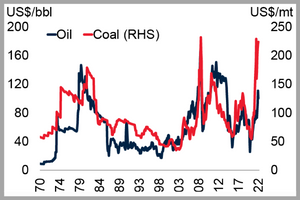 The most dramatic price rises have been for energy; oil and natural gas are leading the charge, but coal prices are rising too.